
All-on-4® treatment can replace a full upper or lower arch of missing or failing teeth with an implant-supported restoration. However, needing extensive tooth replacement does not automatically mean someone is a candidate.
An All-on-4 evaluation looks at much more than whether teeth are missing. The periodontist considers the teeth that remain, gum health, available bone, medical history, bite, planned restoration, cleaning needs, and personal goals.
These findings help determine whether All-on-4 is appropriate or whether another treatment plan may better fit the patient’s oral health and long-term needs.
Patients considering All-on-4 dental implants in St. Louis should expect the consultation to focus on both the surgical foundation and the full-arch restoration it is intended to support.
Are the Remaining Teeth Treatable?
Full-arch implant treatment often begins with an important question: Can any remaining teeth be maintained with reasonable care?
The periodontist evaluates each tooth for decay, fractures, mobility, infection, periodontal attachment, and bone support. Previous treatment and symptoms also matter.
Teeth should not be removed simply because extraction would make the treatment plan easier.
If several teeth have a poor or uncertain prognosis, the periodontist considers how preserving or removing them would affect oral health, maintenance, restorative planning, and the patient’s available alternatives.
The goal is not to move every patient toward full-arch implant treatment. It is to determine which teeth can reasonably be maintained and which treatment approach best fits the overall situation.
What Is the Condition of the Gums?
Dental implants depend on healthy surrounding tissues.
A periodontal examination may include checking for plaque, inflammation, bleeding, gum recession, periodontal pocket depths, and signs of active infection.
Patients with current or previous gum disease may still be evaluated for implant treatment, but their periodontal history remains important.
Active infection may need to be addressed before or as part of treatment planning. A history of periodontitis can also influence the long-term maintenance plan because inflammatory conditions can affect the tissues surrounding implants.
The periodontist also evaluates the amount, thickness, and position of the gum tissue.
These factors may affect how the restoration meets the gums, how easy it will be to clean, and whether additional soft-tissue treatment should be discussed.
Is There Adequate Bone for Implant Placement?
Bone assessment is one of the central parts of an All-on-4 evaluation.
The periodontist needs to understand the height, width, shape, and quality of the bone in the areas where implants may be placed.
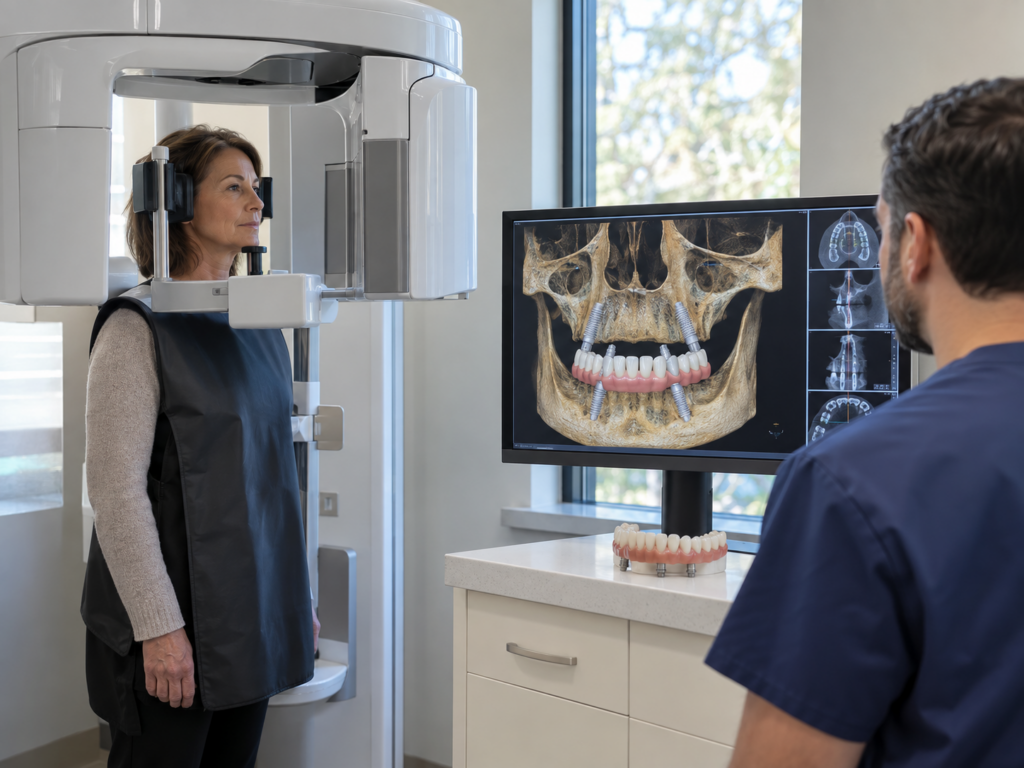
Three-dimensional imaging may be used to evaluate the jaw and identify nearby anatomical structures such as sinus spaces or nerve pathways.
This information can help the periodontist consider possible implant positions and determine whether the available anatomy can support the proposed full-arch plan.
All-on-4 is sometimes considered when bone loss makes other implant arrangements more complicated.
That does not mean every patient can avoid grafting.
Implant number, location, angulation, available bone, and any potential need for bone grafting or another site-development procedure must be evaluated individually.
What Does the Medical History Reveal?
Because implant treatment involves surgery, the periodontist reviews the patient’s overall health as part of treatment planning.
The evaluation may include:
- current and previous medical conditions
- prescription medications
- supplements and allergies
- tobacco or nicotine use
- history and management of diabetes
- medications or conditions that may affect bone metabolism or healing
- blood-thinning medications or bleeding concerns
- previous radiation or surgery involving the head and neck
- prior experiences with dental surgery, anesthesia, or sedation
These factors do not automatically prevent someone from receiving treatment.
They may instead affect timing, risk discussions, healing expectations, coordination with another healthcare provider, medication instructions, or whether another treatment approach should be considered.
Patients should provide a complete and current medical history and should not stop or change prescribed medication without guidance from the appropriate healthcare professional.
How Will the Bite Affect the Full-Arch Restoration?
The periodontist and restorative team also evaluate how the upper and lower jaws meet.
They may consider the opposing teeth or denture, available space, jaw relationship, chewing pattern, and signs of clenching or grinding.
This matters because the implants must support a connected restoration across an entire arch.
Implant positions cannot be planned around available bone alone. The team also needs to consider where the replacement teeth should be positioned, how chewing forces may be distributed, and whether there is enough room for the restoration and its supporting components.
Planning may include photographs, digital scans, impressions, bite records, or a diagnostic tooth setup.
Provider coordination helps connect implant placement with the intended tooth position, function, appearance, and cleaning access.
What Are the Patient’s Goals and Expectations?
Different patients may have different priorities.
One person may want a more stable alternative to a removable denture. Another may be preparing to replace several failing teeth.
The periodontist may ask about eating, speaking, appearance, comfort, previous dental experiences, and expectations for treatment.
The discussion may also include practical questions such as:
- Is the proposed restoration fixed, or are removable full-arch alternatives also being considered?
- What temporary restoration may be used?
- Which providers will complete each stage?
- What limitations may affect appearance or function?
- What maintenance will be required?
- What other treatment options are available?
All-on-4 should not be presented as a guaranteed return to natural teeth.
It is an implant-supported prosthetic treatment with its own maintenance needs, limitations, and potential complications.
Can a Temporary Restoration Be Attached Right Away?
Some treatment plans may allow a temporary full-arch restoration to be attached around the time of implant placement. This is often referred to as immediate loading.
However, this should not be promised before the clinical and surgical requirements have been evaluated.
The decision may depend on bone conditions, implant stability, the planned bite, temporary restoration design, and the periodontist’s findings during surgery.
If those requirements are not met, another temporary plan or a healing period may be recommended.
The temporary restoration is also not necessarily the final prosthesis.
The tissues, bite, and implant sites may need to be reassessed during healing before the definitive restoration is completed.
Can the Patient Maintain the Restoration?
Full-arch implant treatment requires continuing home care and professional monitoring.
Before treatment, the periodontist may consider whether the proposed restoration will allow reasonable cleaning access and whether the patient will be able to follow the recommended maintenance routine.
The discussion may include specialized brushes, flossing aids, water irrigation, professional cleaning, and follow-up visits.
Exact recommendations depend on the restoration design and the patient’s needs.
Previous gum disease, tobacco use, diabetes, and plaque control may also influence the risk of inflammation around implants.
Good maintenance cannot guarantee that implants will last indefinitely, but it remains an important part of protecting the surrounding gums and bone.
What Happens During an All-on-4 Consultation?
The exact consultation varies, but an evaluation may include:
- Discussion of the patient’s concerns, goals, and previous dental experiences
- Review of medical and dental histories
- Examination of the teeth, gums, bite, and existing restorations
- Dental imaging and other diagnostic records
- Assessment of tooth prognosis and possible implant sites
- Discussion of the proposed full-arch restoration and provider roles
- Review of alternatives, treatment stages, risks, and maintenance
Advanced planning technology may also support this process.
The practice uses Yomi® robot-assisted technology for selected dental implant procedures. The system can assist with digital planning and surgical guidance, but the periodontist remains responsible for evaluating the patient, creating the plan, and making clinical decisions.
Technology supports treatment planning. It does not replace professional judgment or guarantee an outcome.
Why Does a Periodontist Perform This Evaluation?
Periodontists receive advanced training focused on the gums, supporting bone, periodontal disease, and dental implant treatment.
That specialty perspective can be particularly relevant when full-arch treatment involves failing teeth, periodontal disease, bone loss, soft-tissue concerns, or several implant sites.
The purpose of the evaluation is not to approve every patient for the same procedure.
Instead, the periodontist considers oral health, function, maintainability, anatomy, restorative goals, and patient priorities before recommending an approach.
Depending on the findings, that may involve All-on-4, another fixed implant-supported restoration, an implant-supported removable denture, a conventional denture, staged treatment, or preservation of selected teeth.
Begin With a Complete Periodontal Evaluation
An All-on-4 evaluation brings the periodontal, surgical, and restorative parts of treatment into one plan.
By assessing the remaining teeth, gums, bone, medical history, bite, restoration design, and maintenance needs, a periodontist can determine whether this approach fits the individual patient.
If you are considering full-arch implant treatment, schedule an All-on-4® evaluation to discuss your oral health, goals, and available treatment options.


